The Four Temperaments
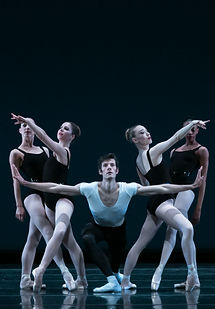
KCB Dancers, George Balanchine's The Four Temperaments. 2015. Photo: Steve Wilson
QUICK F A C T S
- ✦ Choreographed by George Balanchine in 1946, one of the defining works of neoclassical ballet.
✦ Set to Paul Hindemith's Theme with Four Variations, a score commissioned by Balanchine before the ballet was created.
✦ Known for its minimalist presentation, with simple costumes and staging that focus attention on the dancers' movement and musicality.
✦ Inspired by the ancient concept of the four temperaments: Melancholic, Sanguine, Phlegmatic, and Choleric.
✦ Rather than telling a story, the ballet explores abstract movement, structure, and musical form through Balanchine's distinctive choreographic style.
✦ Instead of following a traditional plot, the ballet uses abstract movement to explore ideas of personality, rhythm, and musical structure.

A medieval depiction of the human body. The ancient theory of the four humors eventually inspired the four personality types explored in Balanchine's The Four Temperaments.
S U M M A R Y
The Four Temperaments is a groundbreaking ballet choreographed by George Balanchine in 1946. Rather than telling a traditional story, it explores the ancient theory that human personalities can be divided into four temperaments: Melancholic, Sanguine, Phlegmatic, and Choleric. The ballet begins with a series of themes before introducing each temperament through its own distinctive style of movement, allowing dance itself to become the focus.

Tanaquil Le Clercq and fellow New York City Ballet dancers in The Four Temperaments, circa 1950. Balanchine's groundbreaking ballet abandoned traditional storytelling in favor of pure movement inspired by the ancient theory of the four temperaments.

KCB Dancers George Balanchine's The Four Temperaments, 2015.
Photog: Steve Wilson
The ballet is set to Theme and Four Variations by composer Paul Hindemith. Like the choreography, the music is abstract and does not follow a narrative. Instead, Balanchine used movement to reflect the structure, rhythm, and character of the score. Originally, the production featured elaborate costumes designed by artist Kurt Seligmann, but these were later replaced with simple practice-style costumes that highlighted the dancers' lines and technique.
Although audiences were initially uncertain about the ballet's unconventional approach, The Four Temperaments eventually became one of Balanchine's most celebrated works. Today it is considered a landmark of neoclassical ballet, a style that emphasizes musicality, athleticism, and pure movement over storytelling. Its demanding choreography continues to challenge dancers and fascinate audiences around the world.

Paul Hindemith, whose Theme with Four Variations provided the musical foundation for Balanchine's The Four Temperaments.
E N C O R E
✦ On Today’s Stage
The Four Temperaments remains one of George Balanchine's most frequently performed works and a cornerstone of the neoclassical repertory. Its stripped-down presentation, demanding choreography, and emphasis on pure movement continue to challenge dancers and captivate audiences around the world.
✦ Iconic Interpreters
The ballet has been performed by generations of New York City Ballet dancers since its 1946 premiere. Early interpreters included Tanaquil Le Clercq, Francisco Moncion, and Nicholas Magallanes, while countless later dancers have embraced its athleticism, musical precision, and distinctive style.
✦ Legacy
Often regarded as one of Balanchine's first great neoclassical masterpieces, The Four Temperaments helped redefine what ballet could be. By setting aside traditional storytelling and focusing on music, movement, and abstract ideas, it paved the way for countless modern ballets and remains a landmark of twentieth-century dance.