Les Noces

1965 — A giant white parasol hangs above the wedding procession in Jerome Robbins's Les Noces. Oliver Smith's junkyard set transformed the traditional Russian wedding into a stark modern ritual.
QUICK F A C T S
- ✦ Les Noces means "The Wedding" in French.
✦ The ballet premiered in 1923 with Serge Diaghilev's Ballets Russes.
✦ The music was composed by Igor Stravinsky, who scored the work for voices, percussion, and four pianos.
✦ Choreographer Bronislava Nijinska created the original production, which is considered one of the masterpieces of modernist ballet.
✦ Rather than focusing on a romantic love story, Les Noces portrays the rituals and traditions surrounding a Russian peasant wedding.
✦ In 1965, Jerome Robbins created a famous new interpretation for American Ballet Theatre, setting the ballet within a stark industrial landscape of tires, scrap metal, and giant white parasols.
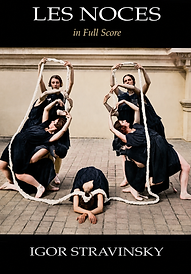
1922 — The published score of Les Noces by Igor Stravinsky. Its driving rhythms and ritualistic atmosphere would inspire generations of choreographers, beginning with Bronislava Nijinska's groundbreaking 1923 ballet.
S U M M A R Y
Les Noces (The Wedding) began as a groundbreaking collaboration between composer Igor Stravinsky and choreographer Bronislava Nijinska. Premiering in 1923 with Serge Diaghilev's Ballets Russes, the ballet depicts a traditional Russian peasant wedding through a series of ritualized ceremonies rather than a conventional story. Stravinsky's driving score for voices, percussion, and pianos creates a powerful sense of inevitability, while Nijinska's geometric choreography emphasizes the collective experience of marriage over individual romance. The result was one of the most influential modernist ballets of the twentieth century.

An American Ballet Theatre dancer in Patricia Zipprodt’s avant-garde costume for Jerome Robbins’s 1965 Les Noces. The stiff, heavily textured garment complements the industrial, tire-strewn set, rejecting traditional ballet elegance for a raw, geometric look.

Four male singers of the chorus standing in a solemn, linear formation as priests during a 1965 performance of Jerome Robbins’s Les Noces.
More than forty years later, choreographer Jerome Robbins created a radically different interpretation for American Ballet Theatre in 1965. Working with designer Oliver Smith, Robbins abandoned the original village setting and placed the wedding within a stark landscape of tires, scrap metal, and industrial debris. Giant white parasols, abstract costumes, and a junkyard-like environment transformed the ballet into a vision of modern life while preserving the ritual power of Stravinsky's music. Though controversial, Robbins's production demonstrated how Les Noces could be reimagined for a new era without losing its emotional force.
Today, Les Noces remains a landmark of twentieth-century dance, admired for its striking fusion of music, movement, and ritual. Whether performed in Nijinska's original form or through later reinterpretations, the ballet continues to fascinate audiences with its exploration of community, tradition, duty, and transformation. More than a wedding celebration, Les Noces reveals how major life events can feel both deeply personal and part of something much larger than ourselves.

An American Ballet Theatre dancer in the form-fitting spandex unitard from Jerome Robbins’s 1965 Les Noces. The sleek garment strips away traditional ballet skirts, creating a sharp silhouette that emphasizes raw physical movement against the industrial backdrop.
E N C O R E
✦ On Today's Stage
Les Noces remains one of the most important modernist ballets in the repertory and is regularly performed by major ballet companies around the world. Both Bronislava Nijinska's original choreography and later reinterpretations continue to influence contemporary dance.
✦ Iconic Interpreters
Bronislava Nijinska's original Ballets Russes cast established the ballet's distinctive style, while Jerome Robbins's 1965 American Ballet Theatre production introduced a new generation to the work. Many leading dancers have since taken part in its powerful ensemble-driven choreography.
✦ Legacy
Widely regarded as a masterpiece of twentieth-century modernism, Les Noces revolutionized the relationship between music, movement, and theatrical design. Its ritualistic structure, geometric choreography, and innovative score helped shape the future of ballet and contemporary dance.