Le Spectre de la Rose

Serge Lifar as the Rose Spirit in Le Spectre de la Rose, photographed by Annemarie Heinrich, 1935.
QUICK F A C T S
- ✦ The ballet was inspired by Théophile Gautier's poem Le Spectre de la rose and premiered with the Ballets Russes in 1911.
✦ The story follows a young girl who dreams that the spirit of a rose comes to life after her first ball.
✦ Michel Fokine created the choreography, while the music was adapted from works by Carl Maria von Weber and arranged by Hector Berlioz.
✦ The original cast featured Tamara Karsavina as the Young Girl and Vaslav Nijinsky as the Rose Spirit.
✦ The ballet is famous for Nijinsky's spectacular final leap through a window, one of the most celebrated moments in ballet history.

The legendary Tamara Karsavina passes on the traditions of Le Spectre de la Rose to a young Margot Fonteyn.
S U M M A R Y
Le Spectre de la Rose is a short, dreamlike ballet that begins after a young girl returns home from her first ball. Exhausted from the evening's excitement, she falls asleep in a chair while holding the rose she wore to the dance. In her dream, the spirit of the flower comes to life and dances with her. Their encounter is gentle, romantic, and fleeting. As the dream ends, the Rose Spirit disappears, leaving behind only the memory of a magical night.

Tamara Karsavina and Vaslav Nijinsky as the Young Girl and the Rose Spirit in the original 1911 production of Le Spectre de la Rose.

Lydia Lopokova and Alexander Gavrilov in Le Spectre de la Rose, one of the signature works of the Ballets Russes.
The ballet was created in 1911 for Sergei Diaghilev's Ballets Russes. Choreographer Michel Fokine based the work on a poem by Théophile Gautier, while Carl Maria von Weber's music was arranged by Hector Berlioz. The original production featured Tamara Karsavina as the Young Girl and Vaslav Nijinsky as the Rose Spirit. The ballet became one of the Ballets Russes' greatest successes, admired for its poetic atmosphere, expressive choreography, and striking designs by Léon Bakst.
Although Le Spectre de la Rose is rarely performed in its entirety today, it remains one of the most influential works of the early twentieth century. The ballet helped move dance away from elaborate storytelling and toward mood, symbolism, and emotion. It is especially remembered for Nijinsky's legendary final leap through a window, one of the most famous moments in ballet history. More than a century after its premiere, Le Spectre de la Rose continues to enchant audiences with its beauty, imagination, and sense of wonder.
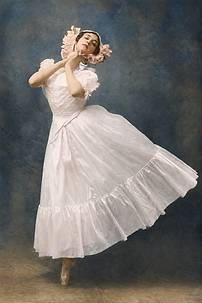
Tamara Karsavina from Le Spectre de la Rose. From a playbill, Théâtre des Champs-Elysées. 1913
E N C O R E
✦ On Today's Stage — Le Spectre de la Rose is performed only occasionally as a complete ballet, but it remains a beloved part of the Ballets Russes legacy and is frequently revived by companies interested in historic twentieth-century repertory.
✦ Iconic Interpreters — Tamara Karsavina and Vaslav Nijinsky created the roles of the Young Girl and the Rose Spirit in 1911. Later interpreters included Serge Lifar, whose performances helped keep the ballet alive for new generations.
✦ Legacy — Le Spectre de la Rose became a defining work of the Ballets Russes and helped establish a new style of ballet built on atmosphere, symbolism, and emotion. Nijinsky's legendary leap through the window remains one of the most famous images in dance history.