Jewels

Photo of Violette Verdy from the performance of George Balanchine's ballet, Jewels. New York City Ballet 1971.
QUICK F A C T S
- ✦ Jewels premiered in 1967 and was choreographed by George Balanchine for New York City Ballet.
✦ The ballet is divided into three sections: Emeralds, Rubies, and Diamonds.
✦ Each section uses different music and reflects a different ballet tradition and atmosphere.
✦ Unlike story ballets such as Giselle or Swan Lake, Jewels has no plot or characters.
✦ Jewels is often considered the first full-length abstract ballet in history.

Photo of Patricia McBride from the performance of George Balanchine's ballet, Jewels. New York Ballet Theater 1967.
S U M M A R Y
Jewels is a full-length ballet created by George Balanchine in 1967. Unlike most famous ballets, it tells no story and features no characters. Instead, Balanchine organized the work around three gemstones—Emeralds, Rubies, and Diamonds—each represented through a distinct style of music, movement, and atmosphere. The result is a ballet that celebrates the beauty of dance itself rather than a traditional narrative.

Unity Phelan and Russell Janzen in George Balanchine's Jewels ("Diamonds") 2017.
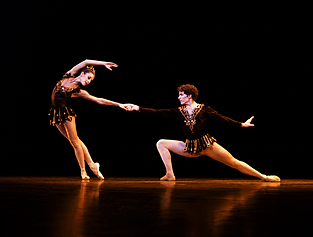
Devon Carney and Leslie Jonas - Rubies by Balanchine, 2013.
KCBalletMedia
Each section has its own personality. Emeralds evokes the elegance and lyricism of nineteenth-century French ballet. Rubies bursts with energy, speed, and jazz-influenced American flair. Diamonds pays tribute to the grandeur of Imperial Russian ballet, with sweeping classical choreography and a majestic final ensemble. Together, the three sections create a journey through different ballet traditions while remaining part of a single work.
Today, Jewels is considered one of Balanchine's greatest masterpieces and one of the first full-length abstract ballets in history. Its innovative structure demonstrated that a ballet could captivate audiences without relying on a plot. More than half a century after its premiere, Jewels continues to shine on stages around the world, admired for its beauty, musicality, and inventive vision.

Rupert Pennefather and Alina Cojocaru in the Diamonds suite from the opening night of George Balanchine's Jewels performed by the Royal Ballet. 2017
E N C O R E
✦ On Today's Stage
Jewels remains a cornerstone of the Balanchine repertory and is regularly performed by major ballet companies around the world. Individual sections—especially Rubies and Diamonds—are also frequently presented on their own.
✦ Iconic Interpreters
The original cast included dancers such as Violette Verdy, Patricia McBride, and Suzanne Farrell, whose performances helped define the distinct personalities of Emeralds, Rubies, and Diamonds.
✦ Legacy
Widely regarded as the first full-length abstract ballet, Jewels transformed expectations of what a ballet could be. Its success proved that dance, music, and visual design alone could sustain an evening-length masterpiece.