Concerto Barocco

Dancers Maria Żuk & Vladimir Yaroshenko in Concerto Barocco by George Balanchine, Polish National Ballet, commons.
QUICK F A C T S
- ✦ Concerto Barocco premiered in 1941 during the American Ballet Caravan’s South American tour.
✦ The ballet was choreographed by George Balanchine.
✦ The music comes from Johann Sebastian Bach’s Concerto for Two Violins in D minor (BWV 1043).
✦ The ballet is considered a major example of neoclassical ballet.
✦ Concerto Barocco does not tell a traditional story and instead focuses on movement, musicality, and pure dance.
✦ The ballet features two principal ballerinas, one principal male dancer, and a corps de ballet of eight women.
✦ Each principal ballerina represents one of Bach’s violin lines, while the corps reflects the orchestra.
✦ The dancers traditionally wear simple practice-style costumes to keep attention on the choreography and music rather than scenery or plot.
✦ Balanchine originally created the ballet as an exercise for students at the School of American Ballet.
✦ The choreography combines classical ballet technique with fast rhythms and subtle jazz-inspired accents.
✦ Concerto Barocco remains one of Balanchine’s most famous and frequently performed ballets worldwide.

Two dancers moving in mirrored, flowing motion, reflecting the musical counterpoint and duality that define Concerto Barocco.
S U M M A R Y
Concerto Barocco is a famous neoclassical ballet choreographed by George Balanchine and inspired entirely by music. Instead of telling a fairy-tale story, the ballet focuses on movement, rhythm, and the beauty of dance itself. Balanchine created the ballet using Johann Sebastian Bach’s Concerto for Two Violins in D minor, allowing the dancers to visually “become” the music on stage. The ballet premiered in 1941 during the American Ballet Caravan’s South American tour.

Symbolic sculptural portrait of Johann Sebastian Bach blending human and skeletal forms, echoing the themes of duality, contrast, and emotional opposites found in both Bach’s music and ballets such as Concerto Barocco.

Concerto Barocco performed by the Polish National Ballet in a modern staging of George Balanchine’s celebrated neoclassical ballet inspired by the music of Johann Sebastian Bach. Dancers: Maria Żuk & Vladimir Yaroshenko, Aneta Zbrzeźniak, and Alicja Złoch. Photo: Ewa Krasucka TW-ON, commons.
The ballet features two principal ballerinas, one principal male dancer, and a corps de ballet of eight women. Each ballerina represents one of Bach’s violin parts, while the corps dances to the orchestra’s musical lines. The dancers wear simple practice-style costumes instead of elaborate sets or storybook outfits because Balanchine wanted audiences to focus completely on the choreography and music. Even though the ballet has no storyline, its sweeping movement and emotional energy make it feel powerful and expressive.
Concerto Barocco became one of Balanchine’s most important works and helped define the style of modern American ballet. Originally created as an exercise for students at the School of American Ballet, the choreography combines classical technique with fast musical rhythms and subtle jazz-inspired accents. Today, the ballet is still performed around the world and is considered one of the clearest examples of Balanchine’s belief that dance and music could exist together without needing a traditional plot.
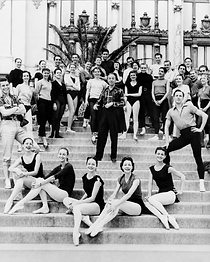
George Balanchine rehearsing dancers of the New York City Ballet in 1955, reflecting the clean neoclassical style associated with ballets such as Concerto Barocco.
E N C O R E
✦ On Today’s Stage
Concerto Barocco remains one of the defining masterpieces of neoclassical ballet and is regularly performed by companies around the world for its elegant fusion of music and movement.
✦ Iconic Interpreters
The ballet is closely associated with George Balanchine and generations of dancers trained in his fast, musical style, including celebrated artists such as Suzanne Farrell and Merrill Ashley.
✦ Legacy
Set to the music of Johann Sebastian Bach, Concerto Barocco helped redefine 20th-century ballet by proving that dance could communicate emotion, structure, and beauty without relying on traditional storytelling.