Apollo

German ballet dancer Falco Kapuste in Apollon musagète (1978), the neoclassical ballet by Igor Stravinsky with choreography by George Balanchine.
QUICK F A C T S
- ✦ Apollon Musagète premiered in 1928 at the Washington Festival with choreography by Adolph Bolm, who also performed the role of Apollo. The ballet’s music was composed by Igor Stravinsky.
✦ Just weeks later, George Balanchine created his own version for Sergei Diaghilev’s Ballets Russes in Paris, beginning the ballet’s long international legacy and helping establish Balanchine as a major choreographer.
✦ The ballet follows Apollo, the ancient Greek god of the arts, and three Muses: Calliope (poetry), Polyhymnia (mime), and Terpsichore (dance and song). Together they guide Apollo toward artistic maturity before ascending to Mount Parnassus, the mythical home of the gods.
✦ Balanchine later shortened the title to simply Apollo and gradually removed much of the original scenery and theatrical detail, creating a cleaner neoclassical style with simple costumes and minimal staging.
✦ Apollo became one of the defining ballets of twentieth-century dance and entered the repertories of major companies around the world, including American Ballet Theatre in 1943, New York City Ballet in 1951, and The Royal Ballet in 1966.
✦ The ballet is widely considered one of the earliest and most important neoclassical ballets, blending ancient mythology with modern movement and Stravinsky’s revolutionary score.
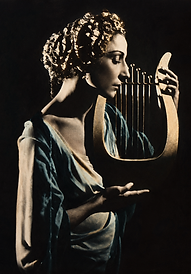
Argentine ballerina María Ruanova as Terpsichore in Apollon musagète, 1928. Photographed at the Teatro Colón in Buenos Aires.
S U M M A R Y
Apollo is one of the most influential ballets of the twentieth century and helped shape the future of modern classical ballet. The score, titled Apollon Musagète, was composed by Igor Stravinsky and premiered at the Washington Festival in 1928. Although George Balanchine later became most closely associated with the ballet, the original Washington production was actually choreographed by Adolph Bolm, who also danced the role of Apollo. Because professionally trained ballet dancers were still rare in the United States at the time, Bolm had to gather and train much of the cast himself. Six weeks later, Balanchine created his own version for Sergei Diaghilev’s Ballets Russes in Paris, beginning the ballet’s legendary international history.

Dancers of Sergei Diaghilev’s Ballets Russes in a 1928 production of Apollon musagète (Apollo), the groundbreaking neoclassical ballet choreographed by George Balanchine to music by Igor Stravinsky.

Teresa Reichlen and Ask la Cour performing in George Balanchine’s Apollo during the Ravello Festival’s “Balanchine in the Dark” program in Italy, 2017.
The story follows Apollo, the ancient Greek god of music, poetry, and the arts, as he is guided by three Muses: Calliope, the muse of poetry; Polyhymnia, the muse of mime; and Terpsichore, the muse of dance and song. Together they help Apollo mature into a leader of artistic harmony before ascending toward Mount Parnassus, the mythical home of the gods. Apollo and Greek mythology had already appeared many times throughout ballet history, especially in eighteenth- and nineteenth-century court and classical works, making Stravinsky and Balanchine’s version feel both ancient and modern at the same time.
Over the years, Balanchine gradually simplified the ballet, shortening the title to Apollo and removing much of the original scenery and storytelling details. Inspired by Stravinsky’s clean, neoclassical music, he emphasized pure movement, simple staging, and iconic white practice-style costumes instead of elaborate mythological sets. These changes transformed Apollo into one of ballet’s defining neoclassical masterpieces, and the work continues to be performed in both traditional and revised forms around the world today.

Costume design for Louis XIV as Apollo in Ballet de la Nuit (1653), illustrated by Henri de Gissey for the lavish French court ballet that helped establish the king’s image as the “Sun King.”
E N C O R E
✦ On Today’s Stage
Apollo remains one of the most frequently performed neoclassical ballets in the world and continues to appear in the repertories of companies such as New York City Ballet, Paris Opera Ballet, and The Royal Ballet.
✦ Iconic Interpreters
Famous dancers associated with Apollo include Jacques d’Amboise, Mikhail Baryshnikov, Peter Martins, and Roberto Bolle, each bringing different interpretations to the role of the young god.
✦ Legacy
Often described as the ballet that launched neoclassicism, Apollo transformed twentieth-century dance by stripping away heavy theatrical spectacle and focusing on musicality, line, and pure movement.